
Why Dungeons and Dragons is a Great Hobby
What Is Dungeons and Dragons?
At its best, Dungeons and Dragons is an open-ended sandbox tapletop roleplaying game (TTRPG) where player characters can decide to attempt anything but usually choose to become legendary heroes. The DM / GM (a.k.a the Dungeon Master / Game Master) sets the stage, introducing the setting and all the characters in the game world except those belonging to the player characters. The rules of the game act as the physics of the collective fiction that the players build together. The outcome of polyhedral dice rolls and the rulings of the DM determine the outcome of player choices. In most cases, the constraints of the rules are exactly the kind of constraints that allow creativity to flourish.
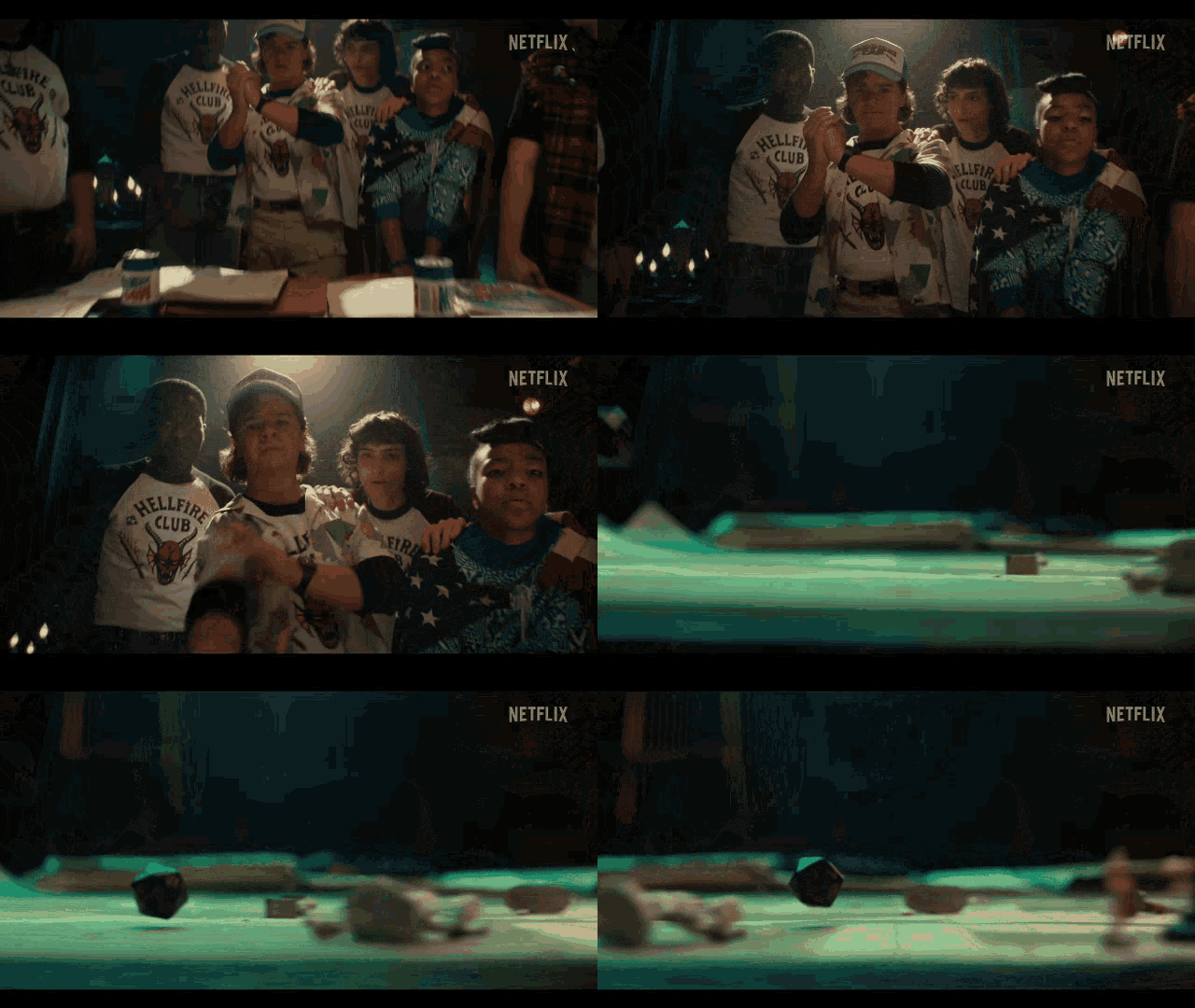
Over time the game has become a medium with all types of stories and media coverage attached. D&D has grown over time from a niche hobby, to a cultural pariah at the center of satanic panic controversy, to a stigmatized nerds-only hobby, to a pop-culture force. For some D&D refers strictly to the mechanics of a game. For others it is an entire multiverse of fiction with canon events in the Forgotten Realms and Grayhawk and Eberron. It is also a huge commercial brand currently under ownership of Hasbro’s Wizards of the Coast that upholds games, movies, tv shows. But ask anyone at the world’s largest and longest running celebration of tabletop roleplaying game culture, and they are likely to tell you that the corporate-and-cultural-baggage is ancillary to Dungeons and Dragons.
Dungeons and Dragons as a hobby is all about playing a game with friends. Whether you play in person or on a virtual tabletop, whether you use free digital or luxury liquid core dice, it is good to gather with friends, tell a story together, and progress as heroes.
Why People Love D&D – It has something for everyone
- Roleplaying – It’s a fun exercise in empathy to place yourself in the shoes of a character you designed. Thinking and speaking as another character can be fun. Especially if you take on a fun accent or explore some quirk.
- Puzzles – Puzzle solvers love unraveling high-court intrigue plots and outsmarting dungeon traps
- Silly conversations – it can be a blast to make a joke character or have your DM introduce the party to a ridiculous NPC
- Power gaming – Optimizer and analytical number crunchers love to find powerful combinations of skills and abilities that make combat trivial
- Genre hopping – D&D’s rule system is most often associated with epic medieval fantasy, but is compatible with most genres. I have personally played in or listened to live-play games ranging from spaghetti western to far future science fiction, eldritch horror to victorian whodunnit, lighthearted contemporary urban fantasy to gritty arctic survival.
- Face-to-face interaction – Like so many hobbies, dungeons and dragons does the important work of bringing people together. If you are busy, socializing is just easier when you have a weekly hold on your calendar and your friends are counting on your svirfneblin soul-knife rogue to safely disarm traps on their way to the dragons lair.
Even for those who like TTRPGs and for whom D&D is not their favorite, it holds a special place because it was the first of its kind.
Though now in its 5th edition (or 5.5th depending who you ask), the original version of Dungeons and Dragons was a first of its kind innovation. David M. Ewalt explains in Of Dice and Men the impact that Gary Gygax and Dave Arenson made in the 1970s when they decided to scale down the top-down batallion-level control of historical war reenactment board games (think Risk but with more math and fact-checking) to the perspective of a single commoner seeking adventure. The process of character creation, now ubiquitous in video games, first took form when players stat down with pencil, paper, and 6-sided die to determine their character stats.
Who might love Dungeons and Dragons
- Teachers who want students to practice math, problem solving, storytelling and interpersonal skills with students
- Players who would find it relaxing to act a little in a low pressure environment
- Sci-fi and fantasy fans who want to build D&D approximations of their favorite characters
- Anyone who loves upgrading, magic item collecting, power-scaling fantasy
- Friend groups looking for an organizing activity to bring them together on a regular basis
D&D Downsides (and why they’re not deal breakers)
Is Dungeons and Dragons hard to learn?
- If it’s your first ttrpg, D&D can feel daunting to learn. There are multiple books to read if you really want to take in everything, and their order of reading is not always intuitive. Fortunately, players don’t need to read everything to get started, since only small slices will be immediately relevant to your character. Plus there are many great content-creators out there, such as the Dungeons Dudes or Ginny Di, that do a great job of making the game accessible for beginners.
If D&D is a sandbox, doesn’t it feel aimless?
- For those used to video game tutorials and more straightforward board games, D&D can at times feel too open ended. Fortunately, a good conversation with a NPC that the DM introduces can resolve that quickly. Listen for rumors. Ask about that mysterious figure from your backstory you’d like to track down. Persuade, intimidate, or investigate your way into finding the next interesting path.
Is Dungeons and Dragons Time Consuming?
- With a single round of D&D combat representing 6-seconds of in game time, a single fight spanning 30 seconds of in-game time may take up to an hour or more. If for some reason you are playing in a campaign with a wilderness survival component where keeping track of items is paramount, a single group shopping trip can span multiple play sessions. Sometimes DMs foreshadow a BBEG (big bad evil guy) in the first session of a campaign only for the grand reveal to take place years later. Fortunately, if time is of the essence for you this is something that can be communicated and planned for at a session 0. All hobbies can be time consuming – after all, they are the things we like losing track of time doing – and dungeons and dragons is no exhibition.
Is Dungeons and Dragons Evil?
- If you are reticent to play a game where the names of real life pantheons are common place and players are as likely to encounter devils and demons as they are fairy queens and krakens, I don’t blame you. Over the years the creators behind Dungeons and Dragons have borrowed names and mythologies from real world myths, legends, and pantheons. Official D&D lore in its various campaign settings has characters that range from rough around the edges to horrendous. The beauty of D&D as a game – as opposed to the more expansive D&D as an intellectual property – is that you and your friends can take what is good, true and beautiful about the game system while casting aside the story elements that you want to avoid. This is another reason why setting shared expectations at Session 0 is so critical.
Can I play D&D alone?
- No easily. Most of D&D is about the power of friendship. If you are someone who prefers to be the main character in all moments, or if you prefer to do your hobbies in peaceful solitude, this is not the hobby for you. Fortunately there are many more out there!
Can D&D rules really hand anything?
- Some TTRPG fanatics will tell you that D&D is too rules light, meaning that the official rules don’t get specific enough in places where it matters. If you are somebody who wants gritty survival, swashbuckling ship to ship combat complete with sailing and artillery mechanics, or even to strut into competent combat on horseback, the Dungeons and Dragons rules as written will probably not suffice for you. Fortunately, there is a large ecosystem of third party content add-ons to D&D that make this possible, as well as D&D inspired number-crunchy spinoffs such as Piazo’s Pathfinder and Starfinder games.
What it takes to play dungeons and dragons.
The Bare Essentials
If you are just getting started, you can play D&D with a couple of free materials online and the stuff laying around your house:
- a set of polyhedral dice
- pencil
- paper
- basic rules
- somebody willing to run the game as dm / gm
- imagination (theater of the mind combat works great, no props required!)
Getting Into It – Some Equipment Upgrades
So you’ve decided you like adventuring. You’re starting to like the sound of dice clacking together. You care where your character is standing and whether its possible to flank the enemy or hide beyond the range of its dark vision. Here is some equipment you might consider as you level up:
- a set or two or five of polyhedral dice – perhaps color coded to match your character
- padded dice tray – so those pesky dice don’t roll off the table when they would have rolled a Natural 20.
- painted miniature or tokens – so you can stop tracking combat position in your head and start seeing it on the table in front of you
- Additional source books – so you can start planning for your next character build from an expanded list of available player species and subclasses
- Dry erase map or printed poster with illustrated aerial view scenery – as a visual aide when exploring or while in combat
- character journal – a stylized way to take notes and track resources that goes beyond the standard character sheet
Taking the Hero of the Realm or Forever DM Option – Dedicated Space
For those who truly love Dungeons and Dragons as a hobby, stopping at official source books and extra dice is often not enough. Below are some of the over-the-top TTRPG luxuries that that can really elevate the hobby to the next level. This is the type of stuff that most people only see if they have the pleasure of going to GenCon in August. (A huge board game convention originally named for where TSR was headquartered at Lake Geneva, Wisconsin, but since moved to the Indianapolis Convention Center, only a 2.5 hours drive from South Bend!)
- Painted miniature terrain and buildings to scale with player and monster miniatures
- game tables with embedded screens – to make use of interactive digital maps at an in-person setting
- commissioned oc character portrait
- physical props such as real glass vials stylized to represent in-game potions
- character costumes
- cards for each spell a caster has learned
- Immersive sound system with ambient and environmental sounds
Did I Miss Something? Are You Missing Something?
Is there something that makes Dungeons and Dragons great that I missed? Is there a glaring fault with the hobby that I’ve failed to acknowledge? Give me a shout!
If your kitchen and coffee tables are crowded and you find yourself running out of space to play Dungeons and Dragons at home, don’t sweat it. You may find a solution in this article. Or, if you’re looking for a solution more specific to TTRPGs, a Tabletop Table may do the trick.
If these solutions fail to meet your needs and you’re still dreaming of dedicated space where you can post your hand drawn-maps or OC character art on the walls and your impressive source book collection can remain on permanent display, could it be time for a move? If you’d like to talk with a real estate agent with expertise in hobbies and homes, I’d be happy to chat.
Pingback: Hobbies At Home – How to Make Space for Your Hobbies -